
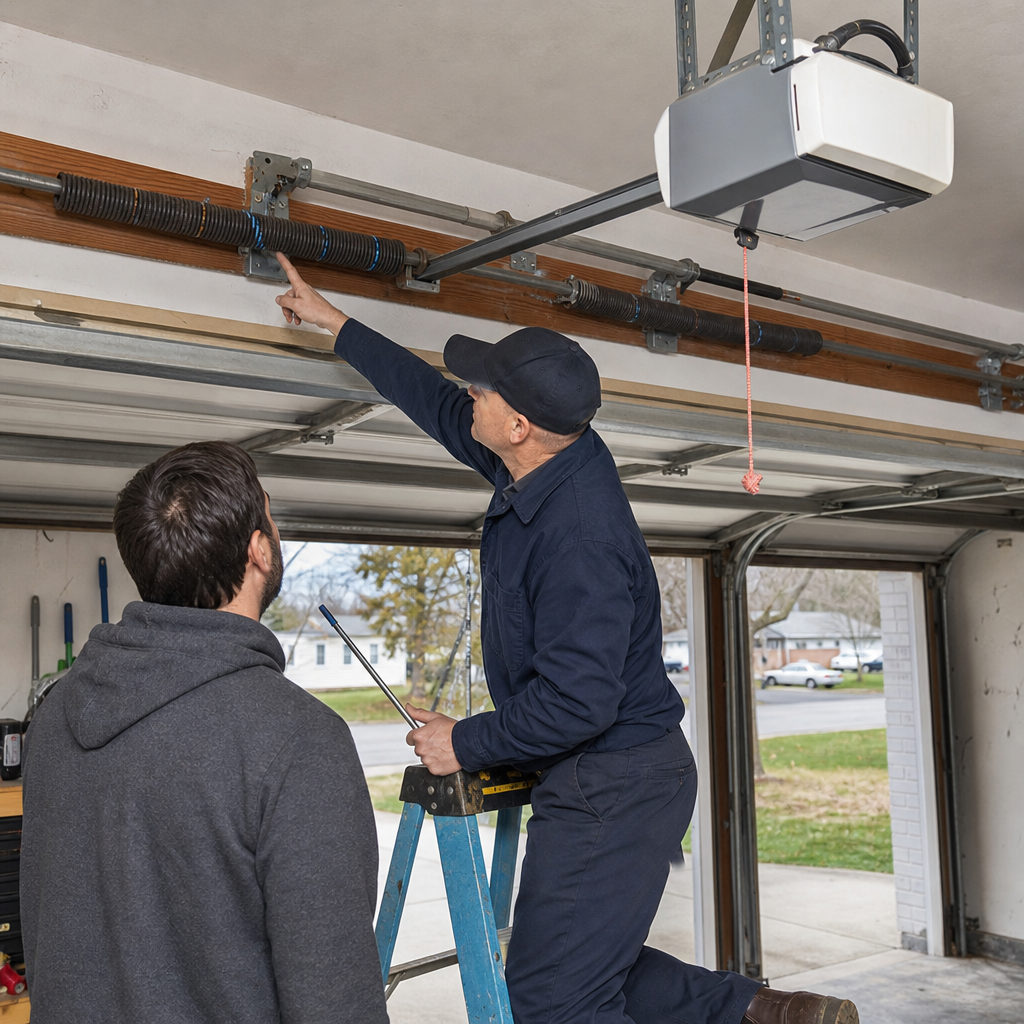
How to Program a Garage Door Opener in New Haven, CT — And Why the Instructions Sometimes Fail Here
Programming a garage door opener typically takes under five minutes: press the learn button on the motor unit until its LED lights, press the button on your remote within 30 seconds, then wait for the light to flash or click to confirm pairing. If you’re in downtown New Haven, near Yale’s campus, or in dense neighborhoods like Wooster Square or East Rock, and that sequence isn’t working, radiofrequency interference from commercial wireless infrastructure and older residential wiring is the likely culprit — not your technique. Call Ironclad Garage Door Repair Greater New Haven at (855) 958-4894 if you’ve cycled through the steps correctly three times; the learn button circuit itself may be failed, and no amount of reprogramming fixes a $15 part.

Why New Haven’s Density Breaks Standard Programming Tutorials
Most online guides assume you’re in a suburban ranch with clear RF airspace. New Haven isn’t that. The city’s packed pre-WWII housing — triple-deckers with converted carriage houses, Victorian-era detached garages tucked behind main structures, and the sheer wireless density around Yale University — creates interference patterns that suburban Milford or Hamden simply don’t face.
We’ve stood in garages on Orange Street where the opener’s 315 MHz or 390 MHz signal gets drowned out by campus equipment, commercial Wi-Fi mesh networks, and the aging electrical infrastructure common in buildings from 1910 to 1945. The remote pairs fine in the driveway but fails once you step inside the garage. That’s not user error. That’s environmental physics, and generic tutorials never mention it because they’re written for Ohio subdivisions.
Quick check: If your remote works when you hold it inches from the motor unit but fails at normal range, interference is almost certainly your problem. The fix usually involves switching to a myQ-enabled opener with 2.4 GHz Wi-Fi pairing, adding a remote extender, or in stubborn cases, replacing the receiver logic board.
Brand-Specific Programming Paths — What Actually Differs
Ironclad technicians are certified across eight major brands, and here’s what most homeowners miss: the learn button color on your motor unit determines which remotes are compatible and which programming sequence you follow. Get this wrong and you’ll chase your tail for an hour.
| Learn Button Color | Frequency / Security | Compatible Remote Types | Typical Brands in New Haven |
|---|---|---|---|
| Yellow | 390 MHz, Security+ 2.0 | 890MAX, 893MAX, myQ-enabled | LiftMaster (2011+), Chamberlain (2011+) |
| Purple | 315 MHz, Security+ | 371LM, 373LM, 971LM, 973LM | LiftMaster (2006–2014), Sears Craftsman |
| Red / Orange | 390 MHz, Security+ | 971LM, 973LM, 81LM | Older LiftMaster, Chamberlain, Raynor |
| Green | 390 MHz, Billion Code | 81LM, 61LM (discontinued) | Pre-2005 units, some Wayne Dalton |
LiftMaster / Chamberlain (yellow learn button): Press and release the yellow button — don’t hold it. The LED turns purple for 30 seconds. Press your remote button once. Two clicks and a light flash mean success. One click means it didn’t take. If you’re pairing to myQ for smartphone control, you’ll need the myQ app and a 2.4 GHz Wi-Fi network; 5 GHz won’t work, and we’ve seen this trip up plenty of New Haven renters in multifamily properties with dated routers.
Genie (Intellicode): Press and hold the program button until the round LED turns blue, then the long LED flashes purple. Press your remote twice. The opener clicks and the long LED turns solid. Genie’s newer Aladdin Connect smart systems require the same 2.4 GHz caveat.
Craftsman (purple or red/orange): Same physical sequence as LiftMaster — Sears units were manufactured by Chamberlain for years — but Craftsman-branded remotes from before 2012 often won’t cross-pair with newer Security+ 2.0 systems. We’ve replaced more “broken” Craftsman openers in Fair Haven and Dixwell than we should have; the opener was fine, the remote was just orphaned by a frequency shift.
Wayne Dalton / Amarr / Raynor: These brands use proprietary rail designs and their own receiver boards. Wayne Dalton’s Quantum and Classic Drive units have a small program button behind the light lens, not a prominent learn button. Raynor’s Aviator and Pilot lines are rebadged LiftMasters with Raynor-specific remotes that won’t pair to standard Chamberlain remotes despite identical internals — a parts-sourcing headache we’ve solved more than once in New Haven’s older neighborhoods.
If it rolls up and down, I’ve fixed it — let’s get yours working right.
Fixed-Code vs. Rolling-Code: The Pre-War New Haven Problem
Here’s where 20 years in this trade pays off. Walk into a garage behind a 1920s triple-decker in Wooster Square or East Rock, and you might find an opener from 1995 still clinging to life. These older units — and some budget replacements installed by landlords who don’t live on-site — use fixed-code DIP switches instead of learn buttons.
Programming these is entirely different: open the remote and the opener’s receiver housing, match the 8–12 tiny switches to identical positions, done. No pairing sequence. No LED feedback. The problem? Fixed-code systems are trivial to clone with a cheap scanner. We’ve advised every New Haven homeowner we’ve encountered with DIP-switch hardware to upgrade — not for convenience, for security. A fixed-code opener in a detached rear garage with alley access is an invitation.
Cost to upgrade: A basic rolling-code opener installation runs $250–$550 in the New Haven market, including removal of the old unit and programming two remotes. That’s less than the deductible on most break-ins, and the modern units integrate with myQ or Aladdin Connect for smartphone monitoring.
When Programming Fails Three Times, Stop — Here’s What’s Actually Wrong
We respect homeowners who want to solve their own problem. But there’s a hard limit to DIY, and it’s usually the third failed attempt.
- Learn button circuit failure: The momentary-contact switch behind that plastic button wears out. Symptoms: LED lights during programming, remote appears to pair, but the opener doesn’t respond afterward. Kevin Flores can replace this $15 part in 20 minutes with the right soldering equipment. No YouTube tutorial shows this repair because it requires disassembling the logic board.
- Receiver logic board degradation: Salt-laden coastal air in waterfront neighborhoods like Fair Haven and Morris Cove corrodes electronics faster than inland Connecticut. We’ve opened motor units where the antenna connection has green oxidation. Cleaning helps; replacement is sometimes necessary.
- RF interference beyond homeowner control: Yale’s expanding wireless infrastructure, commercial mesh networks on Chapel Street, and the density of 2.4 GHz traffic in multifamily buildings create dead zones that no remote programming overcomes.
- Incompatible remote / opener pairing: That Amazon “universal” remote isn’t. We’ve seen homeowners in Dixwell waste hours on generics that don’t support Security+ 2.0.
Our opener repair service runs $120–$320 depending on whether we’re replacing a learn button, swapping a logic board, or diagnosing interference and installing a signal-boost solution. Garage Door Opener service is core to what we do — not an upsell afterthought.
Smart-Home Integration: Where New Haven’s Older Housing Stock Fights Back
Newer LiftMaster and Chamberlain units with myQ integration promise smartphone control, Amazon Alexa compatibility, and geofencing. The reality in New Haven’s rental market? Many multifamily properties run routers that predate 802.11n, or the landlord’s “Wi-Fi included” is a single 2.4 GHz access point drowning in 40 neighboring networks.
The fix most tutorials miss: myQ requires a dedicated 2.4 GHz connection during setup, even if your phone is on 5 GHz. Force your phone to 2.4 GHz, stand within 10 feet of the router, then run setup. If the opener still won’t connect, the router’s 2.4 GHz band may be disabled or overcrowded. We’ve walked property managers through this more times than we can count — it’s an infrastructure problem dressed up as an opener problem.
For homeowners in historic districts like Wooster Square, there’s an additional wrinkle: home automation hardware mounted visibly on a “contributing structure” may require Historic District Commission review if it alters the building’s exterior character. The opener itself is interior; the smart camera or external antenna some myQ accessories use might not be. We’ve seen what looks like a one-day project stall for weeks over panel style approvals — a permitting wrinkle almost unknown in surrounding towns.
What Programming Costs If You Need Professional Help
Most programming issues we handle in New Haven fall into these ranges:
| Service | Price Range | Typical Time |
|---|---|---|
| Remote programming / reprogramming | $120–$180 | 15–30 minutes |
| Learn button circuit replacement | $120–$220 | 20–40 minutes |
| Logic board replacement (interference-resistant) | $220–$320 | 45–60 minutes |
| Opener replacement with smart-home integration | $250–$550 | 2–3 hours |
| Emergency service (nights / weekends) | Standard rates — no upcharge | Same-day response |
When the door won’t move at 10 p.m., that’s what emergency service is for. We don’t charge premium rates for inconvenient hours; it’s a listed core offering, not a profit center.
Key Takeaways: Programming Your New Haven Garage Door Opener
- Match your learn button color to the correct remote and sequence — yellow, purple, red/orange, and green are not interchangeable
- RF interference from Yale’s wireless density and pre-1950 electrical infrastructure is a real, documented problem in downtown and near-campus neighborhoods
- Fixed-code DIP-switch openers in pre-war garages are obsolete and insecure — upgrade to rolling-code
- myQ and smart-home setup requires 2.4 GHz Wi-Fi; New Haven’s older rental routers often default to 5 GHz or disable 2.4 GHz entirely
- Three failed programming attempts means stop — the learn button circuit or logic board likely needs professional diagnosis
FAQs
Professional remote programming or reprogramming in New Haven typically costs $120–$180, while replacing a failed learn button circuit runs $120–$220. If the logic board needs replacement due to coastal corrosion or RF damage, expect $220–$320. Call (855) 958-4894 for an exact quote — estimates are free.
In New Haven’s dense neighborhoods near Yale, downtown, or Orange Street, radiofrequency interference from commercial wireless infrastructure and older residential electrical systems often blocks the 315 MHz or 390 MHz pairing signal. The remote may pair inches from the motor but fail at normal range. If you’ve tried the correct sequence three times, the learn button circuit itself may be worn out — a $15 part that reprogramming can’t fix.
We service and program all eight major brands — LiftMaster, Chamberlain, Genie, Clopay, Amarr, Wayne Dalton, Craftsman, and Raynor — but remotes are not universally cross-compatible. A Raynor-branded remote won’t pair to a Chamberlain opener despite identical internals, and Craftsman remotes from before 2012 often fail on newer Security+ 2.0 systems. Bring us your make and model; 20 years means we’ve fixed this exact problem before.
If your opener uses fixed-code DIP switches, replace it — the security risk in New Haven’s alley-accessed detached garages outweighs any savings. For rolling-code units under 15 years old, repair is usually cost-effective: a $120–$220 learn button fix extends life for years. Replacement at $250–$550 makes sense when the logic board is corroded from coastal air, the unit lacks safety sensors, or you want myQ smartphone integration. Kevin shows up — not a subcontractor, not a trainee — and we’ll give you an honest assessment either way.
Yes. Emergency garage door service is a core offering at Ironclad, not an afterthought with inflated rates. We maintain same-day and after-hours availability throughout Greater New Haven because a non-functional garage door isn’t just an inconvenience in a city with alley-accessed rear garages — it’s a security exposure. Call (855) 958-4894 and we’ll get you sorted.
If you’d rather have it looked at, Ironclad Garage Door Repair Greater New Haven offers a no-pressure assessment in New Haven — call (855) 958-4894.
Written by Kevin Flores, Owner & Lead Technician at Ironclad Garage Door Repair Greater New Haven, serving New Haven, CT.