
Garage Door Opener Installation in New Haven, CT — What Header Clearance Actually Decides
Garage door opener installation in New Haven typically runs $250–$550 and is usually completed same-day when you call (855) 958-4894. But here’s what product pages won’t tell you: in roughly half of pre-war detached garages across this city, standard rail geometry won’t fit. Kevin Flores, our owner and lead technician, measures your header clearance before he ever picks a brand — because in New Haven’s carriage-house conversions, clearance is the decision point that horsepower marketing ignores.

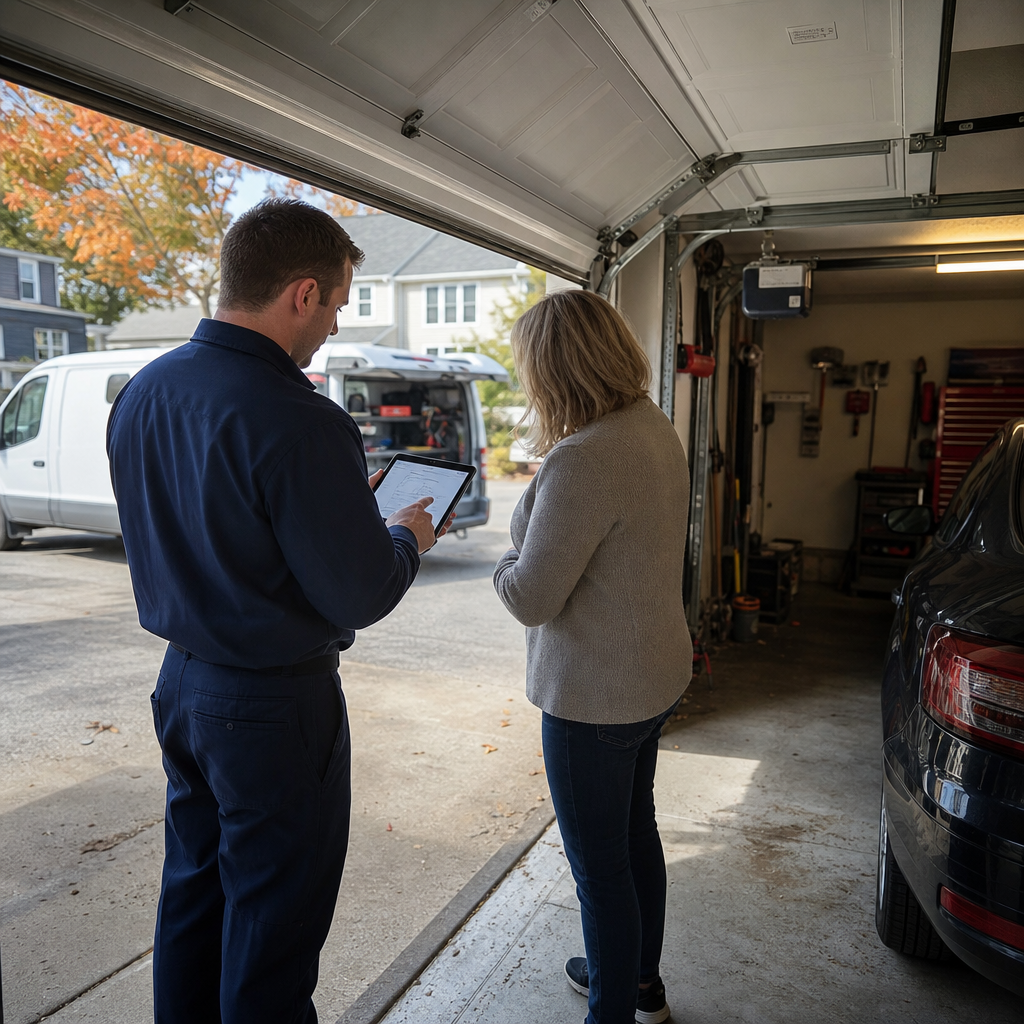
We’ve been installing and replacing openers across Greater New Haven for 20 years. The pattern is consistent. Homeowners in East Rock, Wooster Square, Fair Haven, and Dixwell call us frustrated after a chain outfit’s technician arrives with a standard rail kit, discovers the header’s too tight, and either forces a bad fit or reschedules with “parts on order.” That doesn’t happen when Kevin shows up — not a subcontractor, not a trainee — because he’s already measured your rough opening against the truck inventory before leaving the shop.
Why New Haven Garages Break Standard Opener Specs
New Haven’s housing stock is old and specific. The majority of detached garages in this city predate 1950, many converted from actual carriage houses built between 1910 and 1945. These structures weren’t designed for overhead doors — they were retrofitted decades later with non-standard single-car openings, commonly 8 feet wide rather than today’s 9-foot standard, and severely limited header clearance above the door opening.
Here’s what that means in practice. A standard chain-drive or belt-drive opener from LiftMaster, Chamberlain, or Genie requires roughly 12–15 inches of headroom for the rail assembly and trolley system to operate without binding. In New Haven’s carriage-house garages, we regularly measure 6–10 inches. That gap doesn’t accommodate a standard installation — and it can’t be solved by “a smaller motor.” It requires a low-headroom rail kit, often with a quick-turn bracket system, and sometimes a wall-mount jackshaft opener if the side room allows.
The coastal factor compounds this. New Haven sits directly on Long Island Sound, and salt-laden air accelerates corrosion on hardware year-round — particularly in waterfront neighborhoods like Fair Haven and Morris Cove. We’ve seen torsion springs and bottom brackets deteriorate faster here than in inland Connecticut cities, which means the opener installation isn’t just about the motor; it’s about whether the entire door system can handle the load without failing prematurely. When Kevin recommends a model tier, he’s factoring salt-air exposure into component selection — not just horsepower marketing.
Standard vs. Low-Clearance: What We Measure First
| Configuration | Minimum Headroom Required | Typical New Haven Fit |
|---|---|---|
| Standard rail kit (chain/belt drive) | 12–15 inches | Rare in pre-war garages |
| Low-headroom conversion kit | 8–10 inches | Common requirement |
| Wall-mount jackshaft (side-room dependent) | 6+ inches ceiling clearance | Alternative when header is severely limited |
We carry low-headroom hardware for Wayne Dalton, Craftsman, and Raynor systems on every truck — along with LiftMaster jackshaft units for the tightest spaces. Suburban competitors operating out of Hamden or Milford rarely stock these kits because their market doesn’t demand them. In New Haven, they’re nearly standard equipment.
Brand Certification Matters on Older Door Hardware
Eight brands doesn’t mean eight separate phone calls. We certify on LiftMaster, Chamberlain, Genie, Clopay, Amarr, Wayne Dalton, Craftsman, and Raynor because New Haven’s existing door hardware is a mixed archive. A homeowner in Wooster Square might have a 1980s Raynor door with original track geometry. A triple-decker landlord in Dixwell could be running a Craftsman opener from 2003 on a Clopay door installed by the previous owner. When we arrive, we work with what’s there — or we replace what’s failing without forcing a full system swap.
Brand certification matters because integration points aren’t universal. The coupler between opener rail and door bracket, the safety sensor mounting geometry, the force-limit calibration — these vary by manufacturer. A technician trained only on LiftMaster will struggle with a Wayne Dalton TorqueMaster spring system or a Raynor’s proprietary rail profile. Kevin’s 20 years in the trade means he’s diagnosed and repaired virtually every combination, and our trucks carry the adapters, brackets, and hardware to match.
We don’t upsell full replacements when a targeted opener swap solves the problem. If your door panels, track, and springs are sound, we’ll install a compatible opener that integrates with your existing hardware. If the frame’s out of plumb or the track’s corroded from salt air, we’ll tell you before we start — not after the opener’s mounted and binding.
The Out-of-Plumb Frame Problem: Caught at Installation, Not as a Callback
This is where installation discipline separates a working opener from a warranty call within a year. New Haven’s older detached garages commonly sit on settled, out-of-plumb wooden frames. The header isn’t level. The jambs aren’t square. Install an opener rail on a frame that’s racked even two degrees, and the trolley binds against the rail, the safety reverse triggers erratically, and the motor burns out prematurely.
Chain operations handle this two ways: they ignore it and move fast, or they discover it mid-job, declare the frame “not their scope,” and leave you with a half-finished installation. We’ve seen both outcomes when homeowners call us to fix someone else’s work.
Our process is different. Kevin measures plumb and level on every jamb and header before the opener comes out of the box. If the frame’s out of square, we shim or re-frame as needed — it’s part of the installation, not an extra invoice line. In Fair Haven last spring, we found a carriage-house frame settled three inches on one side from decades of frost heave. We sistered the header, re-hung the jambs, and installed a LiftMaster 8500W jackshaft unit that didn’t need the compromised header at all. The door’s still running smooth. That job took an extra hour on-site and zero return trips.
Twenty years means we’ve fixed this exact problem before.
What New Haven’s Coastal Climate Does to Opener Selection
Wi-Fi connectivity and battery backup are standard selling points on modern openers. In New Haven, they’re also climate decisions. Salt air corrodes circuit boards and degrades battery performance faster than inland environments. We’ve replaced Chamberlain MyQ modules that failed from moisture infiltration in Morris Cove garages, and Genie battery-backup units that lost capacity within two winters of coastal exposure.
Kevin’s recommendation on model tier reflects this. For waterfront properties, we favor sealed-housing designs and hardwired backup power over battery-dependent units when the electrical service allows. For inland neighborhoods like East Rock or upper Dixwell, standard battery backup performs reliably. The point isn’t that one opener is “better” — it’s that the right opener depends on where your garage sits relative to the Sound, how well it’s ventilated, and whether you’re running a heater that cycles humidity.
We bring this up during estimate calls because it’s cheaper to spec correctly than to replace prematurely. Call (855) 958-4894 and tell us your neighborhood — we’ll know the environmental factors before we arrive.
Opener Installation Pricing in New Haven
Our pricing is upfront and specific to what your garage actually needs. The table below reflects installed cost ranges for typical New Haven scenarios, including low-headroom hardware when required.
| Service | Price Range |
|---|---|
| Standard opener installation (chain/belt drive, adequate headroom) | $250–$400 |
| Low-headroom opener installation (conversion kit required) | $320–$480 |
| Wall-mount jackshaft opener installation (space-limited garages) | $380–$550 |
| Opener repair (motor, gear, sensor, or remote issues) | $120–$320 |
| Spring repair | $180–$340 |
| Track realignment | $120–$240 |
| New door installation (full replacement) | $700–$2,200 |
Estimates are free. We don’t charge to measure your opening, assess frame condition, and recommend the right configuration. When Kevin shows up, the right parts are on the truck — no mid-job ordering delays, no “we’ll be back next week.”
What to Compare When You’re Shopping Opener Installation
Most comparison guides focus on horsepower, Wi-Fi apps, and LED lighting. Those specs matter, but in New Haven, they’re secondary to three questions that determine whether your opener actually works:
- Will the rail fit my header? — If the installer doesn’t measure before quoting, you’re gambling on a standard kit that fails in half the garages in this city.
- Does the technician know my door brand? — Integration hardware varies. A “garage door guy” who only stocks one brand’s adapters will force a mismatch or walk away.
- What happens when the frame isn’t square? — If shimming and re-framing aren’t in the installer’s scope, you’ll own the callback when the opener binds.
We’ve answered all three before we leave your driveway. That’s what 138 reviews averaging 4.8 stars reflect — consistent real-world performance, not a handful of curated testimonials.
If you’re comparing us to a chain operation, ask specifically: who arrives, what do they carry, and what do they do when the garage doesn’t match the spec sheet? The answers separate a one-and-done installation from a relationship that starts with a problem.
FAQs
Garage door opener installation in New Haven typically costs $250–$550 depending on headroom clearance, opener type, and whether your frame needs adjustment. Standard installations with adequate clearance start around $250, while low-headroom conversions or jackshaft wall-mount units run higher. Call (855) 958-4894 for a free estimate — we’ll measure your opening and quote the exact configuration your garage needs.
Yes, same-day installation is available for most New Haven properties when you call early in the day. Kevin carries low-headroom kits, jackshaft units, and adapters for all major brands on every truck, so we’re equipped for the specific clearance and compatibility challenges this city’s older garages present. Emergency garage door service is also offered for situations where the door is stuck open or closed — call (855) 958-4894 to check same-day availability.
Opener repair typically costs $120–$320, while new installation runs $250–$550 — so repair is usually cheaper if the motor, gears, and circuit board are still viable. However, if your opener is over 15 years old, lacks safety sensors, or has failed repeatedly, replacement is more economical long-term. We don’t push new units when a targeted repair solves the problem. Call (855) 958-4894 and we’ll diagnose honestly — repair or replace, you’ll know before any work starts.
Many New Haven garages — especially carriage-house conversions in East Rock, Wooster Square, and Fair Haven — have only 6–10 inches of header clearance, below the 12–15 inches standard rail kits require. A low-headroom conversion kit or wall-mount jackshaft opener is necessary for proper function and safety. Installing a standard kit in a tight space causes binding, premature motor failure, and safety reverse malfunctions. We measure every opening before selecting hardware — it’s why our installations don’t generate callbacks.
Ready for an Opener That Actually Fits Your Garage?
Don’t guess at clearance or compatibility. Call (855) 958-4894 for a free estimate, and Kevin will measure your New Haven garage, assess your frame condition, and recommend the right opener configuration for your specific space — with the right parts already on the truck. Ironclad means it holds. If it rolls up and down, we’ve fixed it — let’s get yours working right.
Written by Kevin Flores, Owner & Lead Technician at Ironclad Garage Door Repair Greater New Haven, serving New Haven, CT.