
Genie Garage Door Repair in New Haven: A Homeowner’s Guide
Genie garage door opener repair in New Haven typically costs $180–$340 for common issues like sensor realignment, circuit board replacement, or drive gear service, and most repairs can be completed same-day by a technician familiar with Genie’s proprietary systems. If your Genie opener is blinking four times, the sensors probably aren’t actually blocked—there’s a good chance a bent track or loose mount is vibrating them out of alignment. If you’d rather not troubleshoot this yourself, call us at (855) 958-4894 for a free estimate.
Why Genie Openers Dominate New Haven Garages (and What Breaks)
Walk through Westville, East Rock, or the Annex and you’ll find Genie openers hanging in more garages than you’d expect for a brand that doesn’t advertise as heavily as LiftMaster or Chamberlain. There’s a reason: Genie’s ScrewDrive and belt-drive units from the 2000s and early 2010s were overbuilt. We’ve pulled 18-year-old SilentMax 1200s out of Fair Haven homes that still cycled smooth—just needed a worn carriage swapped and the limit switches reset.
The problem is parts obsolescence. Genie’s Intellicode boards, the Excelerator screw-drive assemblies, and certain PowerMax DC motor units were discontinued with limited aftermarket support. In New Haven’s older housing stock—think the pre-war garages in Wooster Square with 7-foot doors and minimal headroom—we’re seeing more homeowners caught between “repair what I have” and “this thing’s so old the parts are gone.”
Here’s what fails most often on Genie units in our market:
- Safety sensor drift — Not the sensors themselves, but the brackets loosening from seasonal humidity swings and concrete expansion
- Drive gear stripping — Especially on ChainMax units with heavy wooden doors common in West Haven and Milford-adjacent neighborhoods
- Intellicode board failure — Lightning hits near the coast, power surges through New Haven’s older grid, and the logic board takes the hit
- Carriage/wear strip cracking — The plastic components on belt-drive units fatigue after 12–15 years of New Haven’s freeze-thaw cycles
We work on your brand—bring us the make and model. If the sticker’s worn off, the serial number’s usually stamped on the motor housing near the light lens.
Decoding Genie Blink Codes: What Four Blinks Actually Means
Genie’s diagnostic system uses the red or green LED on the motor head to communicate faults. The manual says four blinks equals “safety sensor obstruction.” In our experience across New Haven, Milford, and the shoreline, that’s true maybe 30% of the time.
The other 70%? Bent track sections, loose sensor brackets, or—our favorite—a homeowner who “fixed” it by taping a cardboard box over the sensor to block “interference.” That workaround disables the safety system entirely. If a kid or pet crosses that beam and the door doesn’t reverse, you’re looking at liability, not inconvenience.
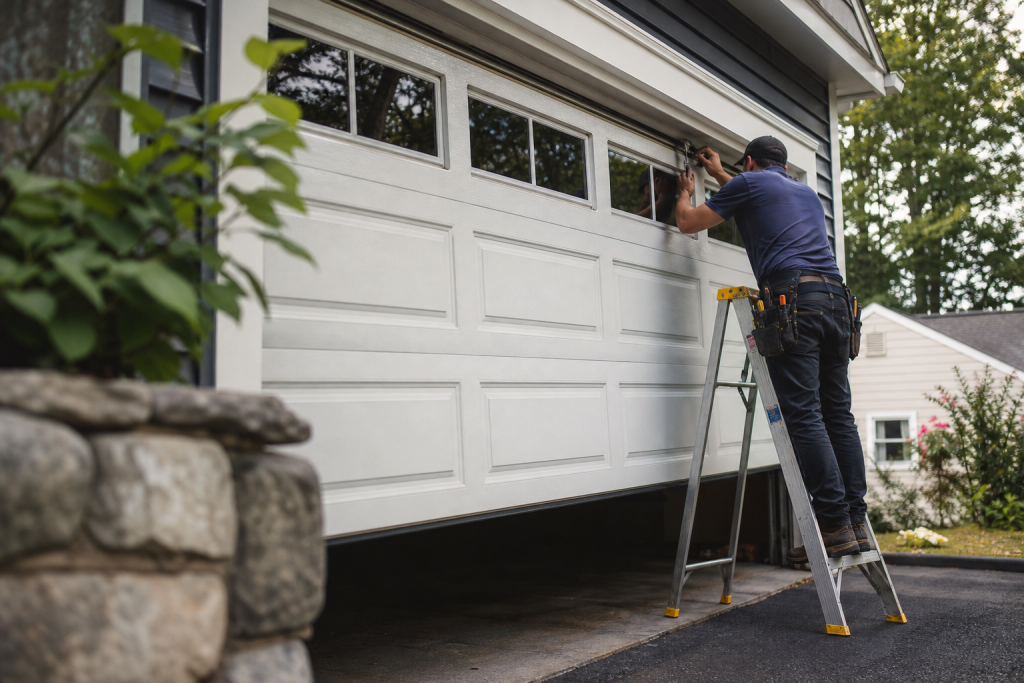
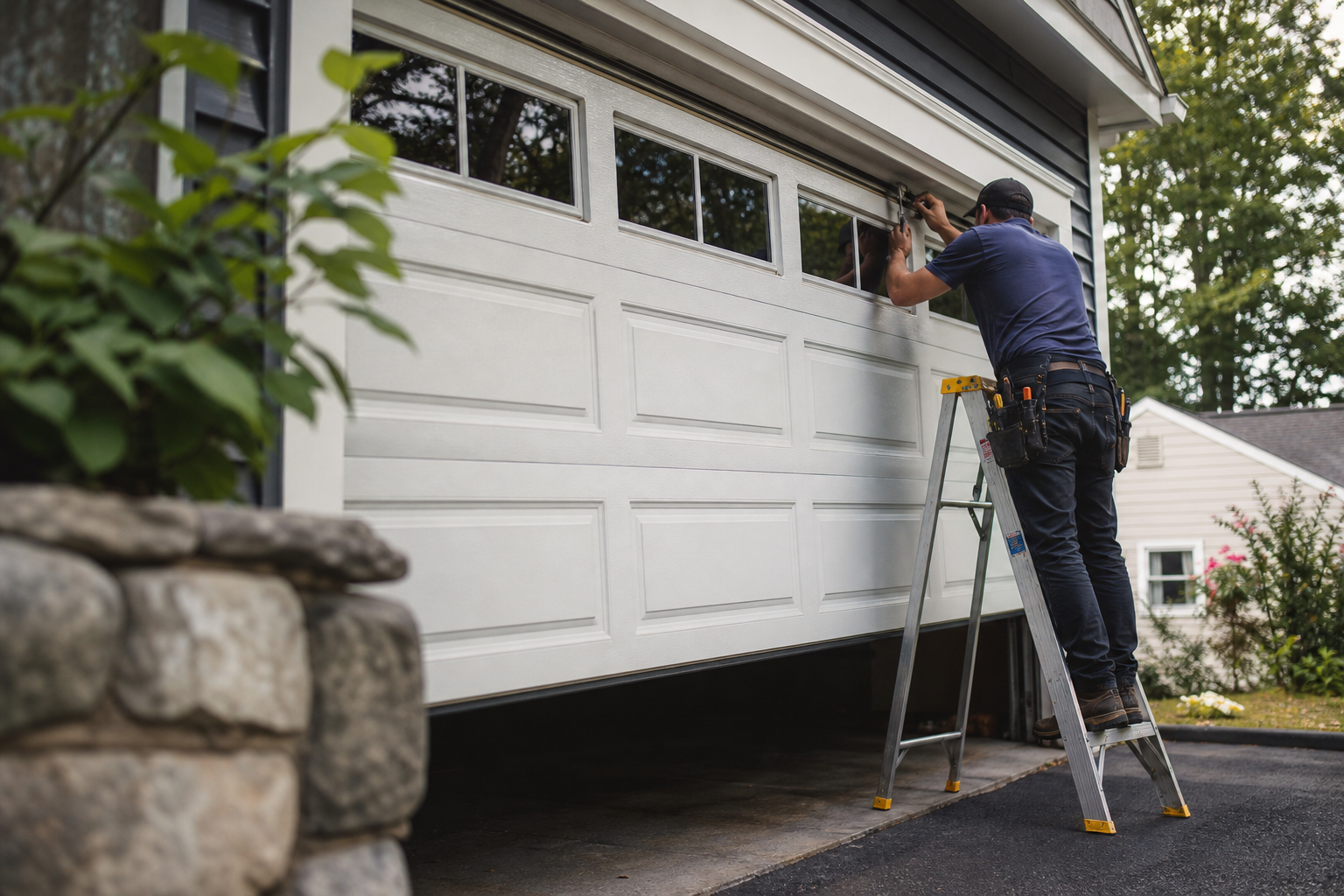
Here’s the actual diagnostic sequence Kevin uses in the field:
- Check the LED colors first. Both sensors should show solid green (or one green, one red on older units). If one is dim or flickering, it’s alignment—not obstruction.
- Wiggle test the brackets. Grab the sensor housing and move it side-to-side. If there’s play in the bracket, the vibration of the door cycle knocks it out of true within a week.
- Inspect the wire path. Genie’s twisted-pair sensor wire degrades where it exits the staple gun holes. In New Haven’s salt-air environment, corrosion travels fast.
- Trace voltage at the board. If sensors read good but the board won’t acknowledge them, the input circuit’s fried—common after coastal power events.
When the door won’t move at 10 p.m., that’s what emergency service is for. We’ve had calls from East Shore homeowners who spent three hours on forum threads before realizing the “fix” they’d attempted removed a safety interlock.
The Sensor Alignment Procedure That Actually Works
Every Genie manual tells you to “adjust sensors until both LEDs are solid.” That’s technically accurate and practically useless if your track is bent or your bracket is fatigued.
Here’s what we do differently:
First, we loosen both brackets and let them hang free. Then we run a string line between the sensor faces—yes, actual mason’s string—to verify they’re not just aligned to each other but square to the door path. A sensor can show green while aimed 3 degrees off; that misalignment fails when the sun hits it at certain angles, which matters in New Haven’s south-facing garages.
We torque the bracket bolts to spec (not hand-tight, not stripped), then cycle the door ten times and recheck. If the LED flickers on any cycle, we find the track joint or roller that’s transmitting vibration.
The “cardboard box trick” and “tape the sensors together” hacks? They bypass UL 325 safety standards. We’ve seen the aftermath in a garage over in Quinnipiac Meadows where a tenant did exactly that, and the door closed on a bicycle frame. The frame lost. A door that doesn’t auto-reverse is a door that doesn’t belong in service.
When to call a pro: If you’ve adjusted sensors twice and the problem returns, the issue isn’t the sensors. It’s structural—track, mount, or board. That’s a garage door repair job, not a sensor job.
Intellicode Remotes, Wall Buttons, and the Confusion Between Them
Genie’s Intellicode system rolls the access code with every use—good for security, frustrating when programming fails. We get calls from New Haven homeowners who replaced the remote battery three times before realizing the wall button was the actual problem.
Here’s the diagnostic split:
- Remote works, wall button doesn’t: Check the button’s wiring first, then the button itself. The constant-up constant-down circuit in Genie wall consoles fails before the radio receiver does.
- Wall button works, remote doesn’t: Likely the remote or the Intellicode receiver board. Try reprogramming—press and hold the learn button until the LED turns purple, then press the remote button twice within 30 seconds.
- Neither works: Board issue, power issue, or—if you have a Genie with integrated Wi-Fi—a firmware lockout that requires a hard reset.
The programming sequence varies by series. SilentMax 1200/1500 units use a purple learn button. Older ChainMax models use red. PowerMax 1500 units have a separate “program” button sequence that’s not in the quick-start guide. If you’re holding the button and the LED never changes color, the board’s not entering learn mode, and no amount of battery swapping fixes that.
Related services in New Haven: If your opener’s failing because the door itself is binding or unbalanced, that’s a garage door opener stress issue that will kill whatever new unit you install. We check door balance and spring tension on every opener service call.
Repair vs. Replace: When Genie Parts Are Gone
This is where 20 years means we’ve fixed this exact problem before. Genie discontinued the Excelerator screw-drive line in 2012. The PowerMax 1200/1500 DC motor boards were last manufactured in 2018. If your unit needs either and it’s not a standard wear part, we’re sourcing from salvage or telling you honestly: the math tips toward replacement.
Current repair viability by series:
| Genie Series | Parts Availability | Typical Repair Range | Replace Threshold |
|---|---|---|---|
| SilentMax 1200/1500 (belt) | Good — carriages, belts, boards still stocked | $180–$290 | Over $400 or 15+ years |
| ChainMax 1000 (chain) | Good — drive gears, chains, sprockets common | $160–$280 | Over $350 or stripped rail |
| PowerMax 1200/1500 (DC) | Limited — boards NLA, motors intermittent | $220–$340 (if parts found) | Any board failure |
| Excelerator (screw) | Poor — screw assemblies obsolete | $200–$320 (salvage parts) | Any drive failure |
| IntelliG 1000/1200 | Moderate — proprietary boards | $210–$330 | Over $380 |
In New Haven’s condo market—particularly the converted industrial spaces in Fair Haven and the medical district—we’re seeing a wave of 2005–2010 Genie units hit end-of-life simultaneously. Property managers call us because they need one vendor who can handle eight brands without dispatching a different subcontractor per building. Kevin shows up—not a subcontractor, not a trainee.
Genie’s Warranty Process: Using Technician Confirmation to Your Advantage
Genie still honors limited warranties on motors and belts for certain series, but there’s a catch: they require a licensed technician’s diagnostic confirmation before they’ll authorize parts or replacement. The homeowner-initiated claim without that confirmation? Denied or delayed 90% of the time, in our experience.
Here’s how to use this:
- 1
Don’t disassemble first. Genie can reject claims where the unit’s been opened by a non-technician.
- 2
Get a written diagnostic. We provide this on every Genie warranty evaluation in New Haven—model, serial, failure mode, and confirmation that the failure’s within warranty terms.
- 3
Submit with photos. We document the LED status, the failed component, and the installation date sticker.
- 4
Use Genie’s online portal, not phone. The callback queue runs 10–14 days; the portal gets a case number immediately.
We’ve had New Haven homeowners get full motor replacements on 7-year-old SilentMax units because we caught a manufacturing-date defect that Genie had quietly acknowledged. Without the technician confirmation letter, they’d have been buying a new opener.
Ironclad means it holds—the name is the standard. That applies to warranty advocacy too. We don’t sell you a new unit if your current one’s covered.
The Bottom Line
Genie builds a solid opener, but “solid” doesn’t mean “simple to fix when it finally fails.” The blink codes are cryptic, the parts situation is getting selective, and the forum advice that ranks on Google often creates bigger problems than it solves. If you’re in New Haven and staring at a blinking LED or a door that reverses for no reason, start with the actual diagnostic: check structural alignment before you blame the sensors, distinguish remote from wall-button failure, and know whether your series still has factory support.
Key takeaways:
- Four blinks usually means vibration or track issues, not true obstruction
- Sensor alignment requires square-to-path verification, not just LED-matching
- Intellicode programming failures often indicate board problems, not remote batteries
- PowerMax and Excelerator series are approaching parts obsolescence—factor replacement into your decision
- Genie warranty claims need technician confirmation; don’t self-diagnose if coverage might apply
If you’re in New Haven, West Haven, Milford, or anywhere in Greater New Haven and need help with a Genie opener, Ironclad Garage Door Repair Greater New Haven offers free estimates—call (855) 958-4894. Kevin handles the diagnostic personally, and if your unit’s under warranty, we’ll document it properly so you don’t pay for a covered failure.
Frequently Asked Questions
Most Genie repairs in the New Haven area run $180–$340, depending on whether it’s a sensor realignment, drive gear replacement, or logic board swap. Obsolete parts like PowerMax boards can push higher if salvage sourcing is required. Call (855) 958-4894 for an exact quote—estimates are free.
Sensor cleaning, remote battery replacement, and basic limit adjustment are reasonable DIY. Anything involving the torsion spring system, drive gear access, or electrical board replacement should involve a technician—we’ve seen homeowners strip gear housings or create safety bypasses that void insurance coverage. If you’re not certain, call before you disassemble.
Check for subtle track misalignment first—especially if your garage gets direct sun or you’ve had recent temperature swings. In New Haven’s coastal climate, bracket expansion and contraction can shift sensor aim by millimeters, enough to trigger false obstruction. If the door reverses at the same point every time, it’s likely a travel limit or force setting issue, not the sensors.
For SilentMax and ChainMax units under 12 years with standard wear parts available, repair’s usually the better value. For PowerMax, Excelerator, or any unit over 15 years needing proprietary components, replacement avoids the “salvage part + labor + still no warranty” trap. We run the math with you—no upsell, just the actual availability and cost comparison for your model.
Written by Kevin Flores, Owner & Lead Technician at Ironclad Garage Door Repair Greater New Haven, serving New Haven since 2006.
Need Garage Door Help?
Call Ironclad Garage Door Repair Greater New Haven — licensed & insured, here with fast after-hours help in New Haven.
(855) 958-4894