
Why Does My Garage Door Reverse in New Haven, CT?
Your garage door reverses because the opener’s safety system has detected resistance it interprets as an obstruction. In New Haven’s older neighborhoods, the most common culprit isn’t misaligned sensors or bad settings — it’s a settled, out-of-plumb wooden frame that creates a binding point during travel, tricking the opener’s force sensor into reversing the door at the exact same spot every time. If your door reverses consistently at one point and your sensors appear clean, the frame itself has likely shifted. Call (855) 958-4894 for a free assessment — we’ll show you exactly what’s happening.

The Real Problem Kevin Sees Most: Your Frame Moved, Not Your Settings
We’ve been called to hundreds of reversing-door jobs across New Haven — from the triple-decker garages in Fair Haven to the converted carriage houses behind Wooster Square Victorians — and the conversation almost always starts the same way. The homeowner cleaned the photo eyes, checked the limit screws, maybe even watched a video on force adjustment. The door still reverses. At the same point. Every single time.
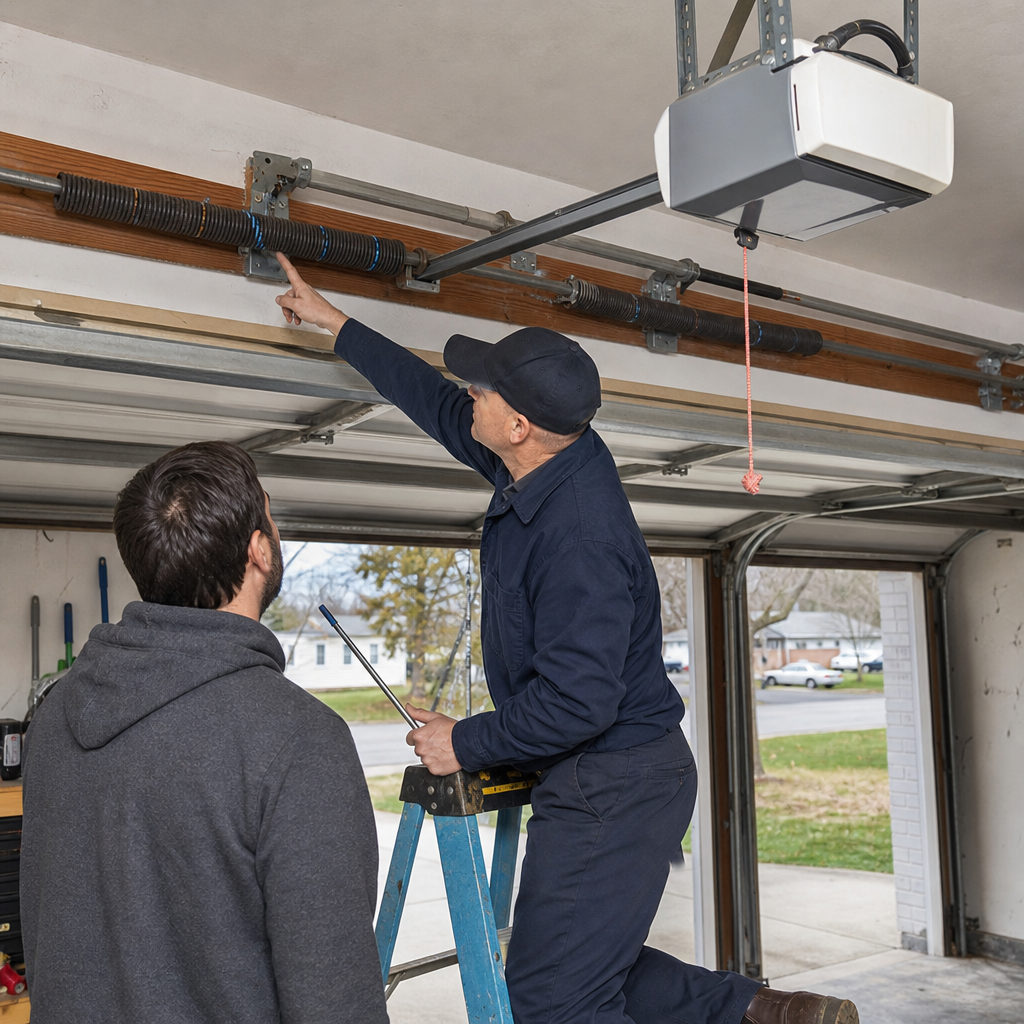
Here’s what we tell them: get down at knee level and watch the bottom corner of the door as it moves through that section of travel. Does the door panel visibly shift, scrape, or torque against the jamb? That’s your answer. The frame has settled, twisted, or bowed — often after decades of freeze-thaw cycles on New Haven’s clay-heavy soils — and the door is physically binding against its own rough opening. The opener, a LiftMaster, Chamberlain, Genie, or whatever you’ve got, is doing exactly what it was engineered to do: detect abnormal resistance and reverse for safety.
Twenty years in this trade means we’ve fixed this exact problem before. The frustrating part is watching homeowners get sold $400 in “opener diagnostics” by techs who never look at the frame. Kevin shows up — not a subcontractor, not a trainee — and the first thing he checks is whether the door moves freely by hand with the opener disconnected. If it binds manually, no amount of electronic adjustment will fix it.
How to Spot a Frame-Binding Reversal vs. a Sensor Problem
- Frame binding: Reversal happens at the identical height every time; door may make a slight groan or scrape; problem worsens seasonally as humidity swells wood or frost heaves concrete
- Sensor misalignment: Reversal is random or immediate; indicator lights blink on one or both sensors; door may reverse before moving more than a few inches
- Force sensitivity issue: Reversal under varying conditions, often with heavier doors; may improve temporarily after adjustment but return as springs weaken
- Spring imbalance: Reversal occurs near top of travel; door feels heavy to lift manually or slams closed
In East Rock and Dixwell especially, we’re working with garage frames built between 1910 and 1945 — many converted from actual carriage houses with 8-foot openings that predate modern standard sizing. The wood headers on these structures move seasonally. We’ve seen sensor mounting brackets shift a quarter-inch just from summer humidity swelling the header, enough to throw off alignment without any actual component failure. That’s a structural issue dressed up as an electronics problem.
Why New Haven’s Climate Makes This Worse
New Haven’s position on Long Island Sound doesn’t just mean good pizza and crowded beaches. That salt-laden coastal air penetrates hardware year-round, accelerating corrosion on torsion springs, cables, and bottom brackets — particularly in waterfront neighborhoods like Fair Haven and Morris Cove. But for reversing doors, the bigger factor is the freeze-thaw cycle.
Every March, Kevin’s phone starts ringing with the same seasonal pattern: “My door was fine in November, now it reverses at the bottom.” What’s happened is the concrete or asphalt threshold has heaved slightly from frost penetration, creating a contact point the bottom seal hits on closing. The opener reads that resistance and reverses. It’s not broken — it’s a safety system responding to a physical change in the structure.
We’ve also tracked a secondary pattern in pre-war garages with dirt or gravel floors. The freeze-thaw repeatedly stresses door seals and causes galvanized tracks to pit faster than in inland Connecticut cities like Waterbury or Hartford. Once track pitting creates enough surface irregularity, rollers bind at specific points and — you guessed it — the opener reverses.
The fix isn’t always a full reframe. Sometimes it’s strategic shimming, threshold grinding, or a low-headroom track kit that changes the door’s geometry enough to clear the obstruction. But you can’t determine that from a YouTube video. You need someone who knows how your specific brand — Raynor, LiftMaster, Chamberlain, Genie — interacts with structural irregularity.
When the Opener’s Force Sensor Is the Problem (Not the Frame)
Let’s be clear: sometimes it actually is the settings. Modern openers have force sensors designed to detect obstruction, and on a properly aligned, freely moving door, these work beautifully. But here’s what the manual won’t tell you — adjusting sensitivity is a workaround, not a fix, and every click upward reduces your safety margin.
We’ve been on jobs where a previous tech cranked the force setting to compensate for a binding door. The door “worked” until a child’s bicycle got caught under it, and the opener didn’t reverse because the threshold for resistance was set too high. That’s not a hypothetical — that’s why we don’t adjust force settings on structurally compromised doors without fixing the underlying binding first.
If your door moves freely by hand and still reverses, then we look at:
- Travel limits: Close-limit set too far, causing the opener to seek resistance that isn’t there
- Force sensitivity calibration: Factory settings drift over years of vibration and temperature cycling
- Logic board issues: Rare, but we’ve replaced enough Chamberlain and LiftMaster boards to know the symptoms
- RPM sensor failure: The opener can’t accurately measure door position, causing erratic reversal behavior
We work on your brand — bring us the make and model. Whether it’s a 15-year-old Genie chain drive or a new Raynor belt-drive with WiFi, we’ve diagnosed the reversal pattern before.
Spring Imbalance: The Reversal That Means Your Safety System Works
A door that reverses near the top of travel presents differently, and it’s often the opener correctly reading abnormal resistance. Here’s what happens: on a dual-spring system, one spring breaks or weakens disproportionately. The remaining spring overpowers the opener’s lifting capacity in the upper travel range, where door weight shifts from being supported by springs to being pulled by gravity. The opener’s force sensor flags this as obstruction and reverses.
This is the safety system working as intended, not malfunctioning. The real problem is the spring imbalance, and continuing to operate the door this way burns out the opener motor prematurely. We’ve replaced $550 openers that failed because the homeowner kept overriding the reversal instead of fixing the $220 spring.
Spring repair in New Haven runs $180–$340 depending on spring type and door size. For context on related services:
| Service | Price Range |
|---|---|
| Spring Repair | $180–$340 |
| Cable Repair | $130–$250 |
| Opener Repair | $120–$320 |
| Track Realignment | $120–$240 |
| General Garage Door Repair | $150–$600 |
When the door won’t move at 10 p.m., that’s what emergency garage door repair is for. We don’t charge premium rates for after-hours calls — emergency service is a core offering, not an upcharge afterthought.
Common Local Scenarios: What Kevin’s Actually Seen
Last March, a homeowner in Wooster Square called about a door that reversed three inches from the floor — every single time, for two weeks. Sensors were clean, lights solid, limits untouched. Kevin found the concrete threshold had heaved nearly half an inch from frost, creating a ridge the rubber seal compressed against. The opener read that compression as obstruction. A grinder, some threshold adjustment, and 45 minutes later, the door sealed properly without overriding safety settings.
In Fair Haven, we see the opposite problem: settled frames that sag in the center, causing the door to bind at mid-travel. The header on a 1920s garage has bowed downward over a century of load, and the top section of the door now scrapes the frame. Homeowners describe this as “it reverses randomly” — but watch closely, and it’s the same height every time. Random isn’t random; it’s physics you haven’t mapped yet.
Dixwell presents its own variation: many garages were retrofitted with modern openers on original frames never designed for the torque and vibration. The opener’s mounting bracket loosens gradually, changing door geometry millimeter by millimeter until a binding point emerges. The “sudden” reversal has been building for months.
These aren’t hypotheticals. They’re patterns from 20 years of walking into New Haven garages, looking at the same brands — LiftMaster, Chamberlain, Genie, Raynor — installed on structures that predate the companies that made them. If it rolls up and down, I’ve fixed it — let’s get yours working right.
What You Can Check Safely (And What Requires a Pro)
With the opener disconnected (pull the red release handle), lift the door halfway manually. It should stay put, move smoothly, and not bind at any point. If it drops hard, springs are likely the issue. If it binds or scrapes, you’ve got a structural problem. Do not attempt to adjust torsion springs yourself — they’re under extreme tension and cause serious injury. Garage Door Repair in New Haven is available for this exact reason.
For sensors: check that both indicator lights are solid (not blinking), lenses are clean, and nothing blocks the beam. On pre-war garages with wooden headers, gently wiggle the bracket — if it moves independently of the frame, seasonal wood movement has compromised mounting stability.
Do not adjust force settings upward to “fix” a binding door. This overrides the safety system that protects children, pets, and property. The correct sequence is: fix the binding, then verify settings are within manufacturer specification.
FAQs
A door that reverses at a consistent height almost always has a physical obstruction or binding point, not an electronics failure. In New Haven’s pre-war housing stock, the most common cause is a settled, twisted, or bowed wooden frame that the door scrapes against during travel. Check by disconnecting the opener and lifting manually — if you feel resistance or hear scraping at that exact point, the frame needs adjustment, not the opener. Call (855) 958-4894 for an exact diagnosis — estimates are free.
Most reversal fixes in New Haven fall between $150–$600 depending on root cause. Frame adjustment or threshold work typically runs on the lower end; spring replacement or track realignment mid-range; opener component replacement reaches the higher end. We provide upfront pricing before any work begins. Call (855) 958-4894 for a free estimate with no pressure to commit.
You can safely check sensor alignment and clean photo-eye lenses, but do not adjust force settings or attempt spring, cable, or track repairs yourself. Torsion springs store lethal energy — Kevin learned this trade through the Building Trades program at Eli Whitney Technical High School in Hamden, and even with formal training, spring work requires specialized tools and safety protocols. If manual lifting reveals binding or the door feels heavy, call a professional. Call (855) 958-4894 and we’ll walk you through what’s safe to check.
Sudden reversal usually means something changed structurally: frost heave raised your threshold, humidity swelled a wooden header and shifted sensor brackets, or a spring broke and changed door weight distribution. In New Haven, Kevin sees threshold heave spike every late winter as frost exits the ground, and header swelling peaks in humid August. The opener didn’t break — the environment changed, and the safety system is responding correctly. Call (855) 958-4894 to identify what shifted.
When to Call Ironclad Garage Door Repair Greater New Haven
If you’d rather have it looked at, Ironclad Garage Door Repair Greater New Haven offers a no-pressure assessment in New Haven — call (855) 958-4894. Kevin Flores, Owner & Lead Technician, brings 20 years of hands-on experience, 138 verified reviews averaging 4.8 stars, and direct accountability for every job. We service all major brands, offer emergency response, and don’t leave until the door works the way it should. Ironclad means it holds — the name is the standard.
Written by Kevin Flores, Owner & Lead Technician at Ironclad Garage Door Repair Greater New Haven, serving New Haven, CT.