
Garage Door Cable Replacement in New Haven — Same-Day Service, Coastal-Grade Hardware
Garage door cable replacement in New Haven typically costs $130–$250 for standard residential doors and is usually completed same day when you call (855) 958-4894. In waterfront neighborhoods like Fair Haven and Morris Cove, we spec coated or stainless cables as standard — not galvanized — because salt-laden air from Long Island Sound corrodes standard cables from the inside out, starting at the drum groove where you can’t see it until the door starts jerking or hangs crooked.
Why That “Off” Door in Fair Haven Is Probably a Cable Problem Hiding in Plain Sight
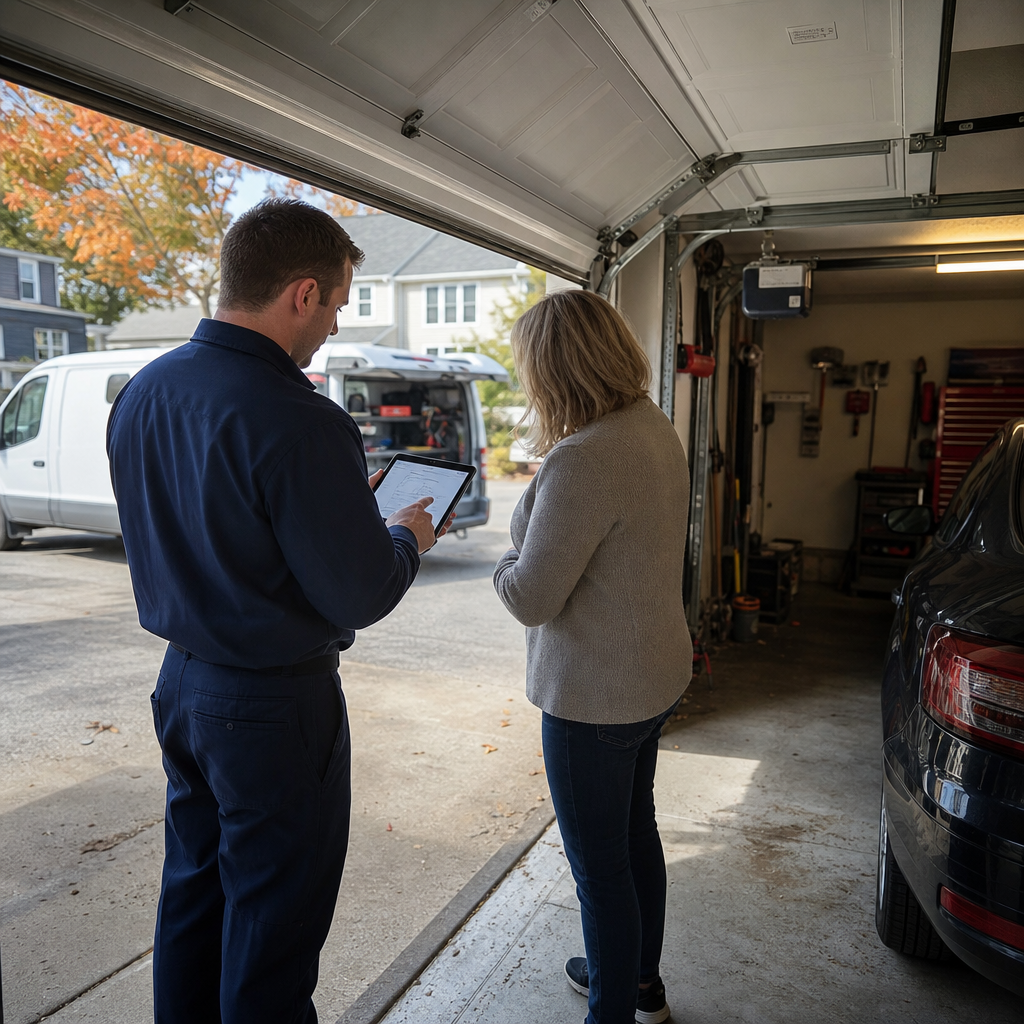
We get the call three or four times a month: door’s “just not right,” maybe a little jerky on the way up, maybe sitting half an inch lower on one side. Homeowner in Morris Cove checked the rollers, checked the track, even WD-40’d everything that moves. The door still feels wrong. Kevin Flores shows up, pops the door in manual release, and the cable at the drum is frayed down to half its strands — surface looks fine, but the salt air worked from the coil interior outward, right where the cable wraps around the drum groove. That’s the highest-stress point, and in New Haven’s coastal climate it’s the first place oxidation wins.
We’ve pulled cables out of Sound-adjacent garages that looked intact to the naked eye. You have to flex the termination and check the drum groove closely to catch it. An inexperienced tech — or a homeowner doing a visual check from the driveway — sees straight track, decent rollers, assumes alignment issue. Realign the track, door still fails two weeks later. Now you’re paying for the same service call twice.
Kevin grew up in Fair Haven, still lives a few miles from where he was raised, and learned the mechanical side of this trade through the Building Trades program at Eli Whitney Technical High School in Hamden. Twenty years of diagnosing garage doors across Greater New Haven means he’s seen this exact salt-corrosion pattern enough times to check it first, not last. When we say “Ironclad means it holds,” we’re talking about cables that actually survive a New Haven winter without turning into rust powder inside their own coils.
How Salt Air Destroys Cables Differently in New Haven’s Waterfront Neighborhoods
The mechanism isn’t complicated, but it’s specific. Long Island Sound puts salt particulate in the air year-round — worse in winter when storms kick it up, worse still when road salt adds to the ambient load. That salt settles on the cable, works into the interstices between strands, and concentrates at the two points where the cable experiences maximum flex and load: the drum groove and the bottom bracket pin.
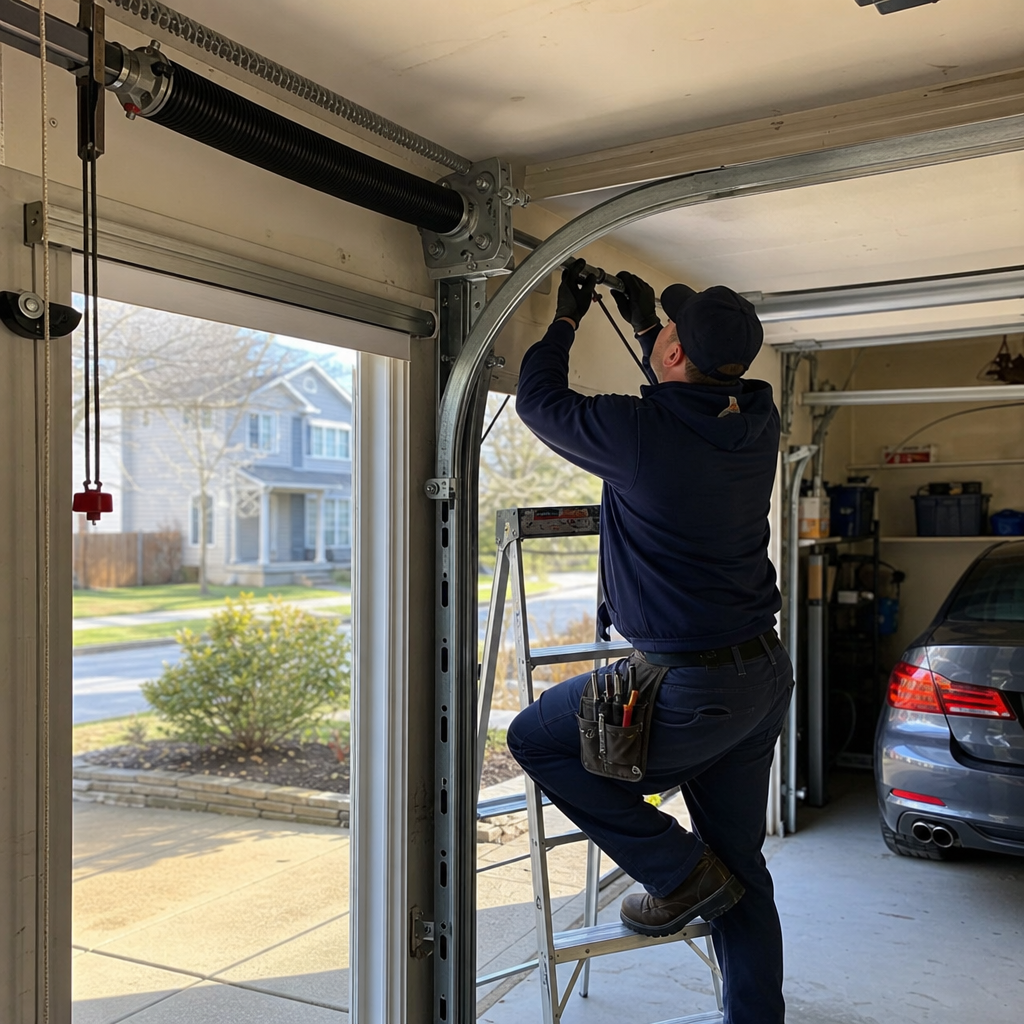
Standard galvanized cables have a zinc coating that degrades fastest where the cable bends repeatedly. In inland climates, that degradation is gradual and mostly external — you see rust, you replace the cable. In New Haven’s coastal microclimates, especially within a few blocks of the water in Fair Haven, Morris Cove, and the eastern edge of East Shore, the salt accelerates oxidation inside the cable bundle first. The outer strands can look acceptable while the core is already compromised. When enough internal strands part, the cable elongates unevenly, the door goes crooked, and the remaining strands fail under the shifted load.
This is why we don’t replace like-for-like with standard galvanized in waterfront New Haven garages. Kevin specifies either:
- Stainless steel aircraft cable — full corrosion resistance, higher upfront cost, longest service life in salt-air environments
- Vinyl or nylon-coated galvanized cable — the coating blocks salt contact with the strands, the galvanized core provides strength, cost sits between standard and stainless
Standard galvanized cable has its place — inland Hamden, North Haven, Wallingford, where salt exposure is minimal and the cost savings matter. But in New Haven proper, within sniffing distance of the Sound, replacing a failed galvanized cable with another galvanized cable is a temporary fix that buys you two years instead of ten. We’ve made that mistake exactly zero times since Kevin figured out the pattern.
The Spring-Cable System: Why One Failure Usually Predicts the Other
Here’s something the chain outfits don’t explain: your torsion spring and lift cables are a coupled mechanical system. The spring provides the torque, the cables transmit it to the bottom corners of the door. They wear together, cycle for cycle, and they fail on similar timelines.
When a cable frays to failure in an older New Haven garage — and we’re talking about the 1910-to-1945 detached garages common in East Rock, Wooster Square, Fair Haven, and Dixwell — the spring that loaded that cable is almost certainly nearing its own fatigue limit. The door may have ten thousand cycles on it, or fifteen thousand, and the spring wire is developing microfractures at the same rate the cable was corroding.
We address both on the same call because a second service trip costs you more than doing it right the first time. Kevin runs the cycle math on every cable replacement: door size, estimated usage, spring age if we can determine it, original install quality. If the spring is over seven years old in a high-use household, we quote spring and cable together. You save the second truck roll, and you’re not calling us back in four months when the spring snaps and the new cable takes the shock load of a failed spring — which can kink or damage a cable that was fine when we installed it.
This matters especially in New Haven’s pre-war housing stock. Those carriage-house conversions and early detached garages often have limited header clearance — sometimes as little as eight or nine inches above the opening — which constrains drum geometry and spring wire sizing. Swapping a cable without rechecking spring tension calculations, or installing a standard drum where a low-headroom drum is required, changes the mechanical load path. We’ve corrected jobs where a previous installer put standard drums in a tight-header garage and the cables wore out in eighteen months from the abnormal wrap angle.
What Cable Replacement Actually Involves — And What It Costs
Every cable replacement starts with securing the door in the open position and releasing spring tension safely. This is not optional, and it’s not a homeowner job: torsion springs store lethal energy, and the winding bars and cable drums interact in ways that can cause serious injury if you don’t know the sequence. We don’t publish step-by-step DIY instructions for cable replacement because we’ve seen what happens when someone with a YouTube tutorial and a socket set tries it. Call a trained professional.
Once tension is released and verified, we inspect both cables (we replace in pairs — mismatched cable age and wear creates uneven lift), check the drums for groove wear, examine the bottom brackets for pin corrosion, and verify spring condition. In New Haven’s coastal climate, we also check track mounting hardware for salt corrosion, since compromised track anchors can shift under load and mimic cable symptoms.
Cable selection depends on door weight, drum type, and environmental exposure. We carry multiple grades on the truck — standard galvanized for inland properties, coated and stainless for waterfront New Haven homes — so we’re not ordering parts and making you wait. Most residential cable replacements run $130–$250 including hardware and labor.
| Service | Price Range |
|---|---|
| Cable Repair / Replacement (pair) | $130 – $250 |
| Spring Repair (torsion or extension) | $180 – $340 |
| Spring + Cable Combo (recommended for older doors) | $280 – $520 |
| Track Realignment | $120 – $240 |
| Roller Replacement | $110 – $220 |
| Opener Repair | $120 – $320 |
The spring-cable combo pricing reflects the efficiency of addressing both wear items in one visit. If your door is original to a pre-1950 New Haven garage, ask us about low-headroom track compatibility and drum geometry when we quote — the wrong drum changes everything, and we measure before we spec.
Emergency Cable Failure: When the Door Won’t Move at All
A snapped cable leaves the door inoperable — one side has lift, the other doesn’t, and the door jams in the tracks or tilts dangerously. If you’re lucky, it happens closed. If you’re unlucky, you’re trying to get your car out for a morning commute or back in during a storm. That’s what emergency service is for.
Ironclad’s emergency garage door repair isn’t an after-hours upcharge slapped on a standard rate. It’s how we’re structured. Kevin or our directly supervised technician responds same day, assesses whether the door can be secured safely, and gets you operational. We carry cables, springs, drums, and hardware for all major brands — Chamberlain, Genie, Clopay, Amarr — so we’re not leaving to source parts while your garage sits open.
In twenty years across Greater New Haven, we’ve handled cable failures at 10 p.m. in winter, during weekend open houses, and on holiday mornings. The pattern doesn’t care about your schedule. Our response doesn’t either.
Why Header Clearance Matters in New Haven’s Older Garages
This is the detail that separates a proper cable replacement from a band-aid job in this market. New Haven’s dense pre-WWII neighborhoods — East Rock, Wooster Square, Fair Haven, Dixwell — are packed with detached garages built between roughly 1910 and 1945, many converted from carriage houses, featuring non-standard single-car openings (commonly 8 ft wide rather than today’s 9 ft standard) and severely limited header clearance. Nearly every replacement job here requires low-headroom track kits and careful drum selection that suburban competitors in Hamden or Milford almost never stock.
Standard cable drums need roughly twelve inches of headroom to wrap properly. Many New Haven garages offer eight or nine. Install a standard drum in that space and the cable stacks unevenly, develops flat spots, and wears prematurely — sometimes failing in months, not years. The correct drum for tight headers is a different part with a modified groove geometry, and it requires recalculating spring torque to match the altered leverage.
Kevin measures header height, rough opening width, and existing drum type before quoting any cable job in these neighborhoods. We’ve seen “simple” cable replacements turn into full track-and-drum corrections because a previous installer ignored the geometry. That doesn’t happen on our calls. We work on your brand — bring us the make and model — but we also bring the field knowledge to recognize when the hardware spec needs to change for the building, not just match what failed.
Key Takeaways
- Garage door cable replacement in New Haven runs $130–$250 for standard residential doors
- Salt-laden coastal air from Long Island Sound corrodes cables internally at the drum groove and bottom bracket — surface appearance is misleading
- Waterfront neighborhoods (Fair Haven, Morris Cove) need coated or stainless cables, not standard galvanized replacements
- Cable and spring wear are coupled; addressing both together prevents a second failure and second service call
- Pre-war New Haven garages often have limited header clearance requiring specialized drum geometry — measure first, spec second
- Ironclad offers same-day emergency response for cable failures with no after-hours upcharge structure
FAQs
Garage door cable replacement in New Haven typically costs $130–$250 for a standard residential door, including both cables, hardware, and labor. Waterfront properties in Fair Haven or Morris Cove may run toward the higher end if we spec stainless or coated cables for salt-air resistance. Call (855) 958-4894 for an exact quote — estimates are free.
Yes, same-day cable replacement is standard at Ironclad, and emergency service is available when the door is inoperable or unsafe. We carry cables, drums, and hardware for all major brands on our service trucks, so we’re not ordering parts and making you wait. Call (855) 958-4894 — Kevin or our technician will assess whether the door can be secured safely and get you operational.
Cables are replaced, not repaired — once frayed or snapped, they’re a wear item with no reliable repair method. Replacement is the only safe option. However, if your spring is also aging, combining spring and cable replacement in one visit costs less than two separate service calls. In New Haven’s older housing stock, we typically recommend this combo when the spring exceeds seven years of age.
A jerky or crooked door, one side hanging lower, or a door that won’t stay on track often indicates cable issues — but salt-corroded cables in New Haven’s coastal climate can look fine from the outside while failing internally at the drum. Don’t assume it’s rollers or alignment without a close inspection of the cable termination points. We check this first on every call, and we don’t charge to diagnose when you proceed with the repair.
Call Ironclad for Garage Door Cable Replacement in New Haven
A failing cable doesn’t fix itself, and in New Haven’s salt-air environment it degrades faster than inland homeowners expect. If your door’s running rough, hanging uneven, or completely jammed, call (855) 958-4894 for a free estimate and same-day service. Kevin Flores, Owner and Lead Technician at Ironclad Garage Door Repair Greater New Haven, personally oversees every cable replacement — we don’t send subcontractors, we don’t upsell parts you don’t need, and we don’t leave until the door works the way it should. If it rolls up and down, I’ve fixed it — let’s get yours working right.
Written by Kevin Flores, Owner & Lead Technician at Ironclad Garage Door Repair Greater New Haven, serving New Haven, CT.